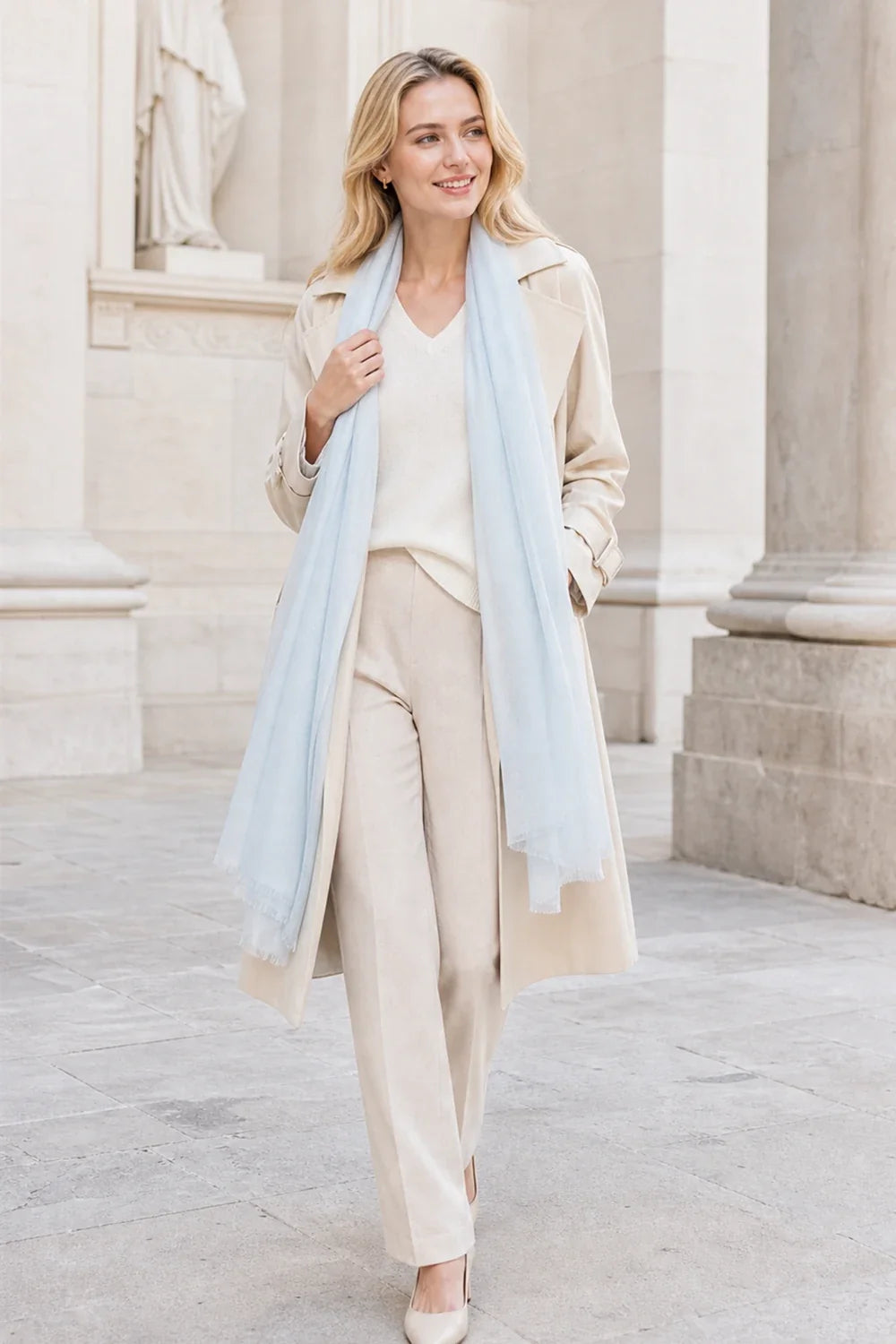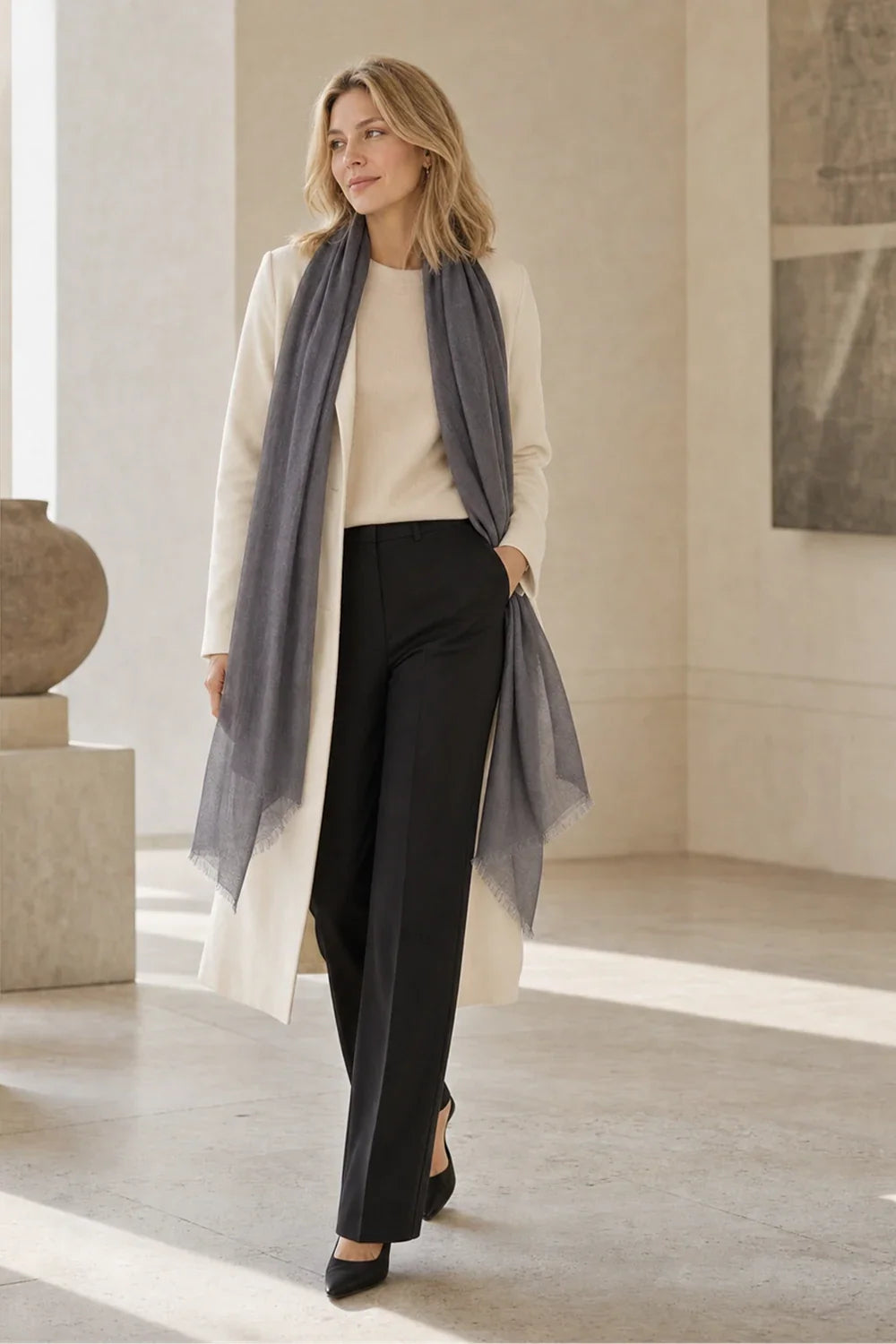

The ends of a scarf are easy to overlook when you are comparing colors and fabrics. Once you put it on, though, they become part of the outfit. Fringe adds movement below a coat’s lapels, while an edge without fringe creates a more defined stopping point.
Both finishes can work well on a 100% cashmere scarf. The choice depends on how you wear your scarf, where its ends fall, and which details you enjoy seeing in an outfit.
What Each Finish Adds
A fringed cashmere scarf has loose or twisted strands extending from its ends. Short fringe creates a subtle border; longer fringe makes the ends more noticeable when you move. The effect also depends on the scarf’s color. Fringe in the same shade as a coat may blend into the outfit, while contrasting fringe stands out.
A scarf without fringe ends in a finished edge. Depending on its construction, that edge may have stitching, a knitted border, or another treatment. Look closely at product photographs rather than assuming every scarf without fringe has the same finish.
Neither design establishes quality on its own. Fringe is a design and construction detail, not proof that a scarf is softer, warmer, or made from better cashmere.
Think About How Much of the Scarf You Show
If you usually wear your scarf in a loose drape, the ends remain visible down the front of your outfit. In this arrangement, fringe becomes a deliberate part of the look. It can add detail to a plain coat without introducing another color or pattern.
If you tuck the scarf completely inside your jacket, the finish may have less influence on the appearance. Comfort and the amount of fabric inside the jacket become more useful considerations.
A single loop falls somewhere between the two. The ends sit higher on the chest, so fringe appears closer to buttons, lapels, or jacket pockets. Try to picture that placement when looking at a scarf laid flat online.
When considering an Audingull 100% cashmere scarf, look for photographs showing its full length as well as its neckline styling. The ends can disappear in tightly cropped images.
Check Whether Fringe Is Included in the Length
A measurement can be misleading if you do not know where it starts and ends.
Some product measurements include fringe, while others describe the main body of the scarf. If two scarves have the same listed length but only one has long fringe, the amount of continuous fabric available for wrapping may differ.
For example, imagine a scarf listed as 72 inches long, including 3 inches of fringe at each end. Its main fabric section would be approximately 66 inches. That distinction matters if you want enough fabric for a full wrap with both ends tucked inside a coat.
If the product description does not make this clear, ask whether the measurement includes the fringe. Compare the answer with a scarf you already wear comfortably.
Pair the Finish With Your Outerwear
With a plain wool coat, fringe can provide a small amount of texture below the lapels. You might leave both ends visible or tuck one end inside for a less symmetrical arrangement.
A scarf without fringe can work well when you prefer a clear, uninterrupted outline. This may appeal to you with a structured blazer, a coat with prominent buttons, or outerwear that already includes several visible details.
These are flexible styling choices. A fringed scarf can look appropriate with tailored clothing, and a scarf without fringe can feel relaxed with jeans and a sweater.
Consider the point where the scarf ends meet your clothing. If long fringe falls directly over a jacket pocket, belt buckle, or decorative fastening, adjust the drape so each detail has a little space.
Consider Your Everyday Movements
Try the scarf with the bag you carry most often. Notice whether the ends hang beside a zipper, brush against rough hardware, or fall under a shoulder strap.
Long fringe may need occasional repositioning around these details. A finish without fringe removes those loose strands, although the scarf’s main fabric still needs care around rough surfaces.
The distinction can also matter when you sit at a desk or table. If the ends regularly fall into your lap, a shorter drape or an inside tuck may be more convenient than leaving them loose.
Your preferred finish should fit these ordinary movements. A scarf that needs a small adjustment now and then may suit you perfectly; another wearer may prefer ends that stay fully contained inside a coat.
Look Closely at the Ends Before Wearing
Check that the finish appears intentional and reasonably consistent. Fringe may be deliberately loose, twisted, fine, or substantial, so judge it against the design rather than expecting one particular appearance.
On a scarf without fringe, examine the edge for pulled threads, unexpected gaps, or sections that seem unfinished. On a fringed scarf, notice whether any strands are caught together or wrapped around a label attachment.
Separate a light tangle gently with your fingers. Avoid pulling firmly on a strand, since you may place tension on the fabric where it meets the fringe.
If you are thinking about cutting fringe shorter or removing it entirely, first confirm how the edge is secured. Altering it can change both the appearance and the stability of the finish. A tailor familiar with delicate textiles can assess the particular scarf.
Frequently Asked Questions
Does fringe make a cashmere scarf more formal?
Fringe alone does not determine formality. Color, texture, thickness, and the rest of the outfit have a greater combined influence. A restrained fringed scarf can work with tailoring, while a bold version can become a more noticeable accessory.
Can a scarf without fringe still be 100% cashmere?
Yes. Fiber content and edge design are separate characteristics. Read the composition information to confirm the material.
Will fringe make the scarf warmer?
Fringe is primarily a finishing detail. For warmth, consider the main fabric’s coverage, construction, and how the scarf fits with your outerwear.
Which finish is easier to pack?
Either can pack comfortably. With fringe, lay the strands within the fold so they do not become caught in the bag’s zipper. With either finish, avoid forcing the scarf into a space that pulls or compresses its edges.
Before choosing, picture your usual coat and the way you leave home wearing it. If the scarf ends will be visible, decide whether you enjoy the movement of fringe or the outline of a finished edge. If you mostly tuck them away, give more attention to the usable length and how comfortably the scarf fits inside the collar.