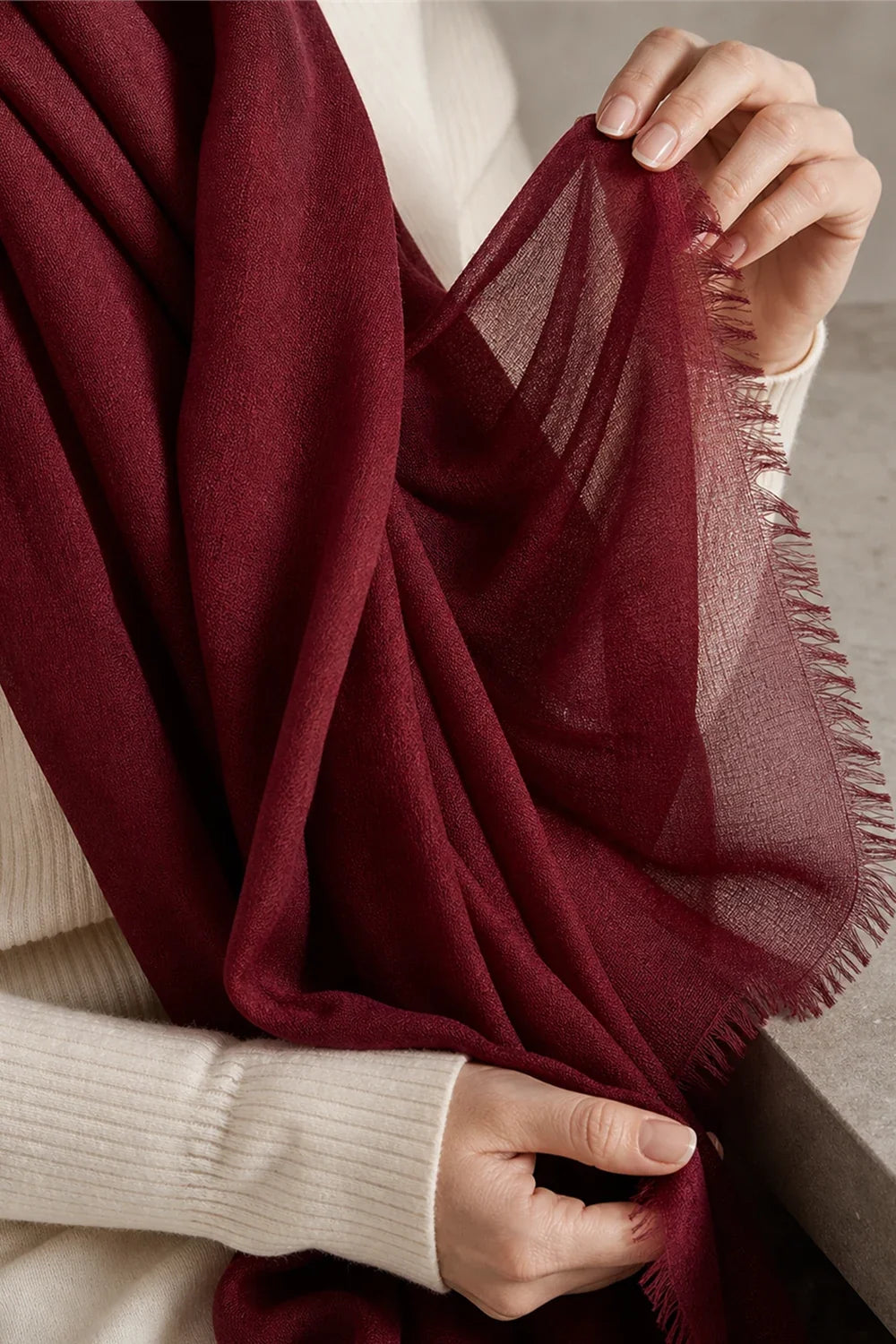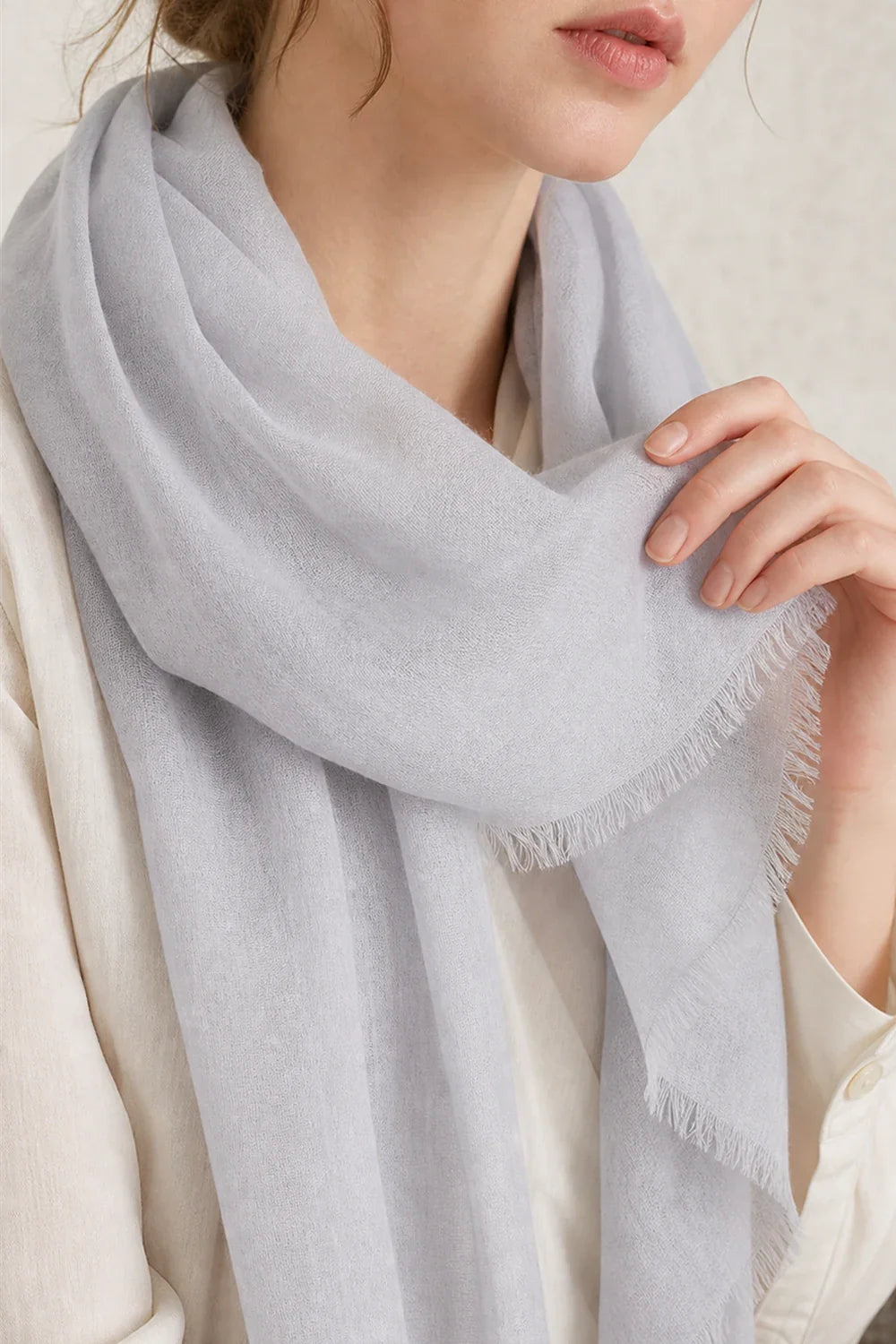

A 100% cashmere wrap can provide warmth across the shoulders without requiring a structured jacket or heavy additional layer. It can be worn at the office, carried while traveling, placed over a dress, or gathered around the neck when the weather becomes cooler.
However, the words “100% cashmere” describe only the fiber content. They do not tell you everything about the wrap’s size, weight, construction, finish, or suitability for your wardrobe.
When considering an Audingull cashmere wrap or comparing other options, look beyond the composition line. The most useful wrap is one that feels comfortable, works with your clothing, and suits the situations in which you plan to wear it.
What Does “100% Cashmere” Mean?
A label stating “100% cashmere” indicates that the textile’s listed fiber composition is cashmere rather than a blend with wool, cotton, or synthetic fibers. Always read the complete product description and physical care label, as trims or decorative details may be listed separately.
Pure fiber content does not create a single standard feel. Two 100% cashmere wraps may differ because of:
- Fiber selection
- Yarn construction
- Weave or knit structure
- Fabric density
- Finishing method
- Overall dimensions
- Edge construction
- Dyeing and printing processes
This is why it is useful to examine several product details instead of making a decision based on the percentage alone.
Cashmere Wrap, Shawl, or Stole?
These terms often overlap, and their use varies between brands.
A cashmere wrap is generally a wide rectangular piece that can cover the shoulders and upper body. A shawl may be rectangular, square, or triangular, while a stole is often narrower and associated with shoulder draping.
The product name is less important than its measurements. Before purchasing, check the listed length and width to understand how much coverage it will provide.
If possible, compare those measurements with a scarf or blanket you already own. This simple step can give you a more accurate sense of scale than model photographs alone.
Decide How You Plan to Wear It
The best size and weight depend on the wrap’s intended role.
For Indoor Layering
If you want an additional layer for an air-conditioned office, restaurant, or home workspace, look for a wrap that covers both shoulders without overwhelming your seated posture.
It should be wide enough to remain in place when draped, but not so long that the ends fall into your lap or catch on chair arms.
For Travel
A travel wrap should offer enough coverage for a cool flight, train journey, or changing destination weather. It also needs to fold easily into your carry-on.
Consider the balance between coverage and packing space. A larger wrap can feel comforting during transit, while a lighter design may be easier to carry throughout the trip.
For Dresses and Events
A wrap worn with dresses should cover the shoulders comfortably while allowing the outfit underneath to remain visible.
Think about where the ends will fall, whether you want to cover the upper arms, and whether you will need to hold the wrap in place. A fluid drape may suit seated dinners, while a slightly more compact size can be easier when walking or greeting people.
For Outdoor Wear
If the wrap will be used outdoors, check whether it fits over sweaters, jackets, or coats. A thin wrap may sit comfortably beneath loose outerwear, while a wider style may work better over the top.
For regular winter commuting, a traditional cashmere scarf may stay in place more easily. A wrap is most practical outdoors when broader shoulder and chest coverage is the priority.
Look Closely at the Dimensions
Online photographs can make a wrap appear larger or smaller depending on how it is folded and styled. Product measurements provide a more reliable reference.
Consider three questions:
- Is it wide enough to cover both shoulders?
- Is it long enough to drape or wrap in your preferred way?
- Will it fit inside your usual travel or work bag?
A very wide wrap offers more coverage but may require frequent adjustment. A narrower design is easier to manage, although it may function more like an oversized scarf.
Your height and shoulder width can also affect how the same dimensions look. There is no universally correct size.
Consider Weight and Construction
Cashmere wraps can be light and airy, substantial and warm, or somewhere between the two. The product’s construction influences how it hangs and where it feels most useful.
A lightweight wrap may suit:
- Mild weather
- Air-conditioned spaces
- Spring and fall layering
- Carry-on travel
- Outfits that need a soft finishing layer
A more substantial wrap may suit:
- Colder temperatures
- Outdoor dinners
- Winter travel
- Extended shoulder coverage
- Layering over knitwear
Weight alone does not determine quality. A lightweight wrap may be intentionally designed for portability, while a denser construction may prioritize warmth and structure.
Choose according to how and where you expect to wear it.
Examine the Surface and Edges
When viewing a cashmere wrap in person, look at it in natural light. The surface should appear generally even, although cashmere naturally has a soft halo.
Run clean hands lightly across the fabric. It should feel comfortable without leaving a large amount of loose fiber behind. A few loose surface fibers can occur, particularly with a new item, but excessive shedding deserves closer attention.
Inspect the edges as well. Depending on the design, they may be:
- Fringed
- Hemmed
- Rolled
- Left with a soft woven finish
No single edge style is automatically preferable. Check that it appears even, secure, and appropriate for the wrap’s construction.
When shopping online, use close-up images to examine texture and finishing. A clear return policy is also helpful when feel and drape are important to your decision.
Do Not Judge Cashmere by Softness Alone
Softness matters, especially for something worn near the neck and face. Still, the softest first impression does not necessarily provide a complete picture of the wrap.
Finishing treatments can influence how cashmere feels when new. Construction, stability, shape retention, and surface behavior also matter over time.
Consider the full product:
- Does the fabric look evenly constructed?
- Does it return to shape after being handled?
- Are the edges finished neatly?
- Is the wrap’s weight appropriate for its purpose?
- Does it shed heavily during normal handling?
- Does the seller provide clear composition and care information?
A well-considered purchase balances softness with practical construction.
Choose a Color That Works With Your Wardrobe
Because a wrap covers a relatively large area, its color has a noticeable effect on an outfit.
Before choosing, look at the coats, dresses, sweaters, and trousers you wear most often. A wrap that coordinates with several of them is likely to receive more use.
Neutral Colors
Black, gray, navy, cream, and camel can move easily between work, travel, and evening outfits. These shades are useful when you want one wrap to serve several purposes.
Muted Colors
Burgundy, forest green, dusty blue, and soft rose can add color while remaining easy to combine with neutrals.
Brighter Colors
A stronger color can become the central feature of an otherwise simple outfit. It may work especially well if most of your wardrobe is black, navy, white, gray, or denim.
The wrap does not need to match your shoes and bag. Repeating one related shade elsewhere in the outfit is often enough.
Six Simple Ways to Wear a Cashmere Wrap
A wide cashmere wrap does not require an elaborate knot.
1. The Even Shoulder Drape
Place the center of the wrap across your back and let both ends fall evenly over your arms. This works with dresses, blouses, and sleeveless tops.
2. The One-Shoulder Drape
Begin with the wrap across both shoulders, then place one end over the opposite shoulder. This provides a little more security while keeping the shape relaxed.
3. The Front Wrap
Place the center behind your neck and bring both ends across the front of your body. Leave them loose or cross them gently without tying.
4. The Gathered Scarf
Fold or gather the wrap lengthwise and place it around your neck like an oversized scarf. This is useful outdoors, although the additional fabric may feel bulky beneath fitted outerwear.
5. The Belted Wrap
Drape the wrap over your shoulders and secure a belt around your waist over the fabric. Make sure the belt is smooth and not tight enough to crush or pull the cashmere.
6. The Seated Travel Layer
Place the wrap across your shoulders and arms while seated. Keep it away from floors, tray tables, luggage wheels, and rough seat hardware.
What to Wear With a Cashmere Wrap
A wrap can move between casual and polished outfits.
For everyday wear, pair it with jeans, a simple shirt, and loafers or boots. Let the cashmere add texture without introducing several other accessories.
For work, wear it over a blouse, fine sweater, or tailored dress. A solid wrap can sit comfortably beside subtle patterns and structured clothing.
For dinner, drape it over a sleeveless or long-sleeved dress. Choose a shade that complements the outfit rather than trying to find an exact match.
During travel, combine it with comfortable trousers, a breathable top, and a light jacket. The wrap can be removed and folded when the temperature changes.
Is a 100% Cashmere Wrap a Practical Gift?
A cashmere wrap can be a thoughtful gift because it does not require the precise fit of a sweater or coat. However, size, color, and care requirements still matter.
Before choosing one, consider:
- The recipient’s usual colors
- Their local climate
- Whether they travel frequently
- Their preferred level of warmth
- Whether they wear scarves or shoulder wraps
- Their willingness to care for delicate fibers
A neutral or muted color may be easier to incorporate into an existing wardrobe. Include the care information so the recipient knows how to store and clean it.
How to Care for a 100% Cashmere Wrap
Always begin with the specific care label. Do not assume that every cashmere item can be cleaned in the same way.
If hand washing is permitted:
- Fill a clean basin with cool water.
- Add a small amount of detergent suitable for cashmere or delicate wool.
- Lower the wrap into the water without rubbing or scrubbing.
- Rinse according to the label instructions.
- Support the full weight of the wet fabric.
- Press out moisture gently without wringing.
- Roll it inside a clean towel to absorb excess water.
- Reshape it and dry it flat away from direct heat and sunlight.
A large wrap requires enough flat space to support the entire piece. Do not allow part of it to hang over the edge, as the weight of the wet fabric may cause stretching.
If the label specifies professional cleaning, follow that instruction.
How to Reduce Pilling
Pilling can occur when loose fibers become tangled through friction. It does not automatically mean the wrap is unsuitable or poorly made.
To limit unnecessary friction:
- Avoid carrying rough shoulder straps over the wrap.
- Keep it away from hook-and-loop fasteners.
- Rotate it rather than wearing it every day.
- Store it folded instead of hanging.
- Do not rub stained areas.
- Remove surface pills only when needed.
If pilling appears, place the dry wrap on a flat surface and use a cashmere comb with light, controlled strokes. Do not pull pills off with your fingers.
How to Store a Cashmere Wrap
Clean the wrap before storing it for an extended period, since body oils, food residue, and unnoticed stains can attract pests or become harder to remove.
Fold it loosely and place it in a breathable cotton storage bag. Keep it in a clean, dry drawer or shelf away from direct sunlight and strong fragrances.
Avoid hanging it for long periods. A wrap’s weight can place stress on the fabric and gradually change its shape.
Do not store cashmere while damp, and avoid long-term storage in an airtight plastic bag where moisture may become trapped.
A Practical Online Shopping Checklist
Before ordering, confirm that the product page provides:
- Fiber composition
- Full dimensions
- Product weight, when available
- Close-up fabric images
- Edge and fringe details
- Care instructions
- Color information
- Shipping and return terms
Also consider how the wrap is shown. Look for photographs of it laid flat as well as worn over the shoulders. Multiple views make it easier to understand scale and drape.
Frequently Asked Questions
Is 100% cashmere better than a cashmere blend?
They serve different preferences. A 100% cashmere wrap offers the feel and characteristics of pure cashmere, while blends may be designed for a different texture, structure, weight, or price. Evaluate each product according to its intended use.
Is a cashmere wrap warm enough for winter?
It can provide useful warmth, particularly across the shoulders and upper body. In cold conditions, it should be combined with appropriate outerwear rather than treated as a replacement for a winter coat.
Can a cashmere wrap be worn as a scarf?
Yes. Gather or fold it lengthwise and place it around the neck. Because it is wider than a conventional scarf, it may feel bulky beneath a fitted coat.
Is a cashmere wrap useful on a plane?
It can provide an adjustable layer when cabin temperatures change. Keep it away from floors and rough surfaces, and store it in a clean pouch when it is not being worn.
How often should a cashmere wrap be washed?
There is no fixed schedule. Air it between wears and clean it when necessary according to its care label. Washing more often than needed may place avoidable stress on the fibers.
Should a cashmere wrap be hung or folded?
Folding is generally more suitable for storage. Hanging a large cashmere piece for an extended period can place stress on the fabric.
Final Thoughts
A 100% cashmere wrap should be chosen for more than its fiber label. Dimensions, weight, construction, color, care requirements, and intended use all influence how well it will fit into your wardrobe.
Think about the real situations in which you want to wear it: at work, during travel, over a dress, or as a cool-weather layer. A thoughtfully selected Audingull 100% cashmere wrap can provide adaptable coverage while remaining easy to combine with clothing you already own.