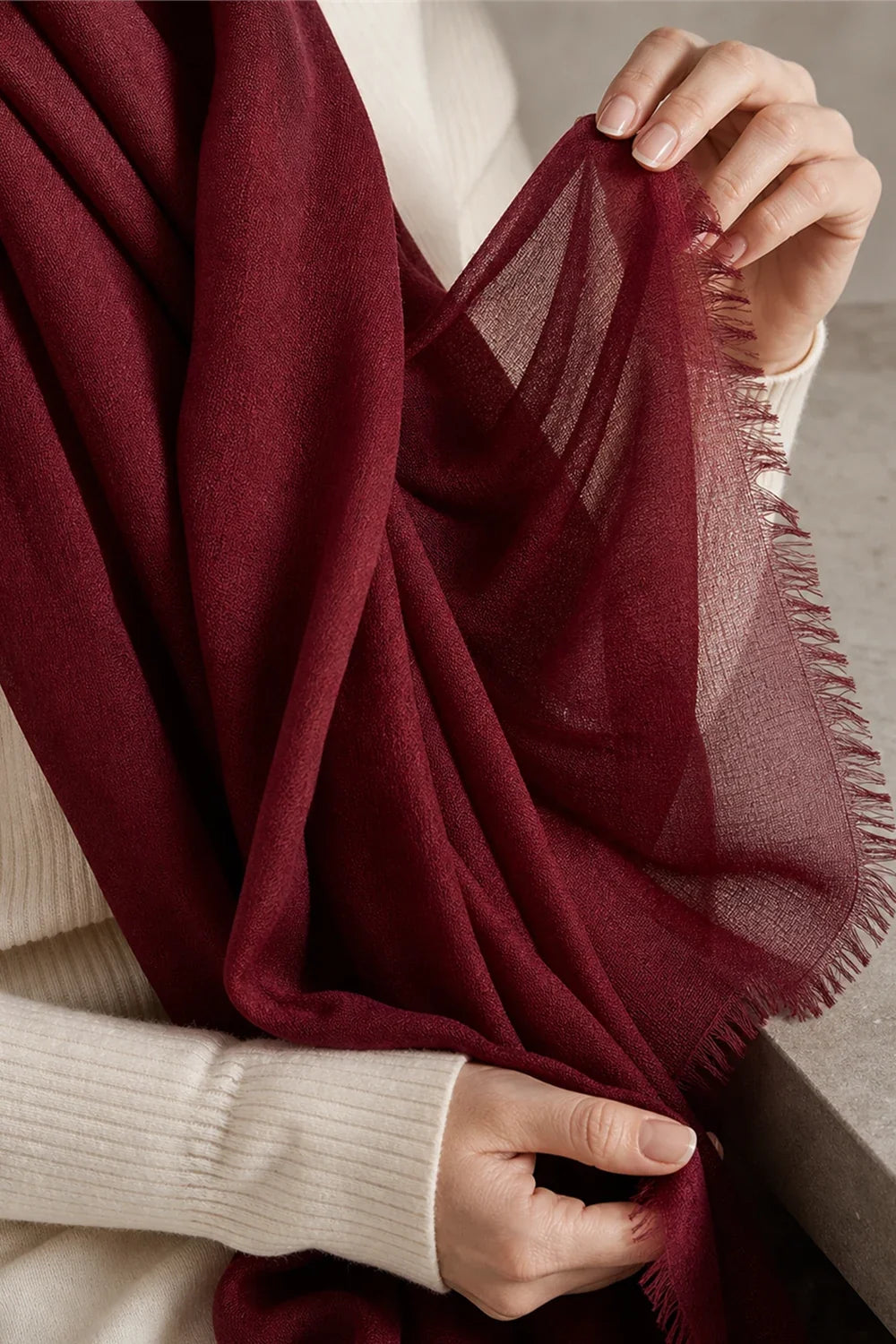

A cashmere scarf and a cashmere wrap may be made from the same type of fiber, but they serve different purposes. A scarf is usually narrower and designed primarily for the neck, while a wrap provides enough width to cover the shoulders and upper body.
Neither option is automatically more useful. The right choice depends on your climate, wardrobe, travel habits, and preferred way of wearing accessories.
At Audingull, we think the most practical starting point is not “Which one looks better?” but “When and where will I actually wear it?” This guide will help you answer that question.
What Is a Cashmere Scarf?
A cashmere scarf is generally a long, relatively narrow accessory worn around the neck. It may be folded, looped, knotted, or tucked beneath a coat.
Because it uses less fabric than a wrap, a scarf is usually easier to wear during daily activities. It fits naturally with jackets and coats and can often be stored in a handbag or small travel bag.
A cashmere scarf may suit you if you want:
- Warmth concentrated around the neck
- An accessory for commuting or outdoor walks
- Something that fits beneath a coat
- A simple addition to everyday outfits
- A compact option for travel
- Several knotting and looping possibilities
Sizes differ between products, so check the measurements rather than relying only on the word “scarf.”
What Is a Cashmere Wrap?
A cashmere wrap is wider than a typical scarf and is designed to cover the shoulders, arms, or upper body. Some wraps may also be described as shawls or stoles, although brands do not always use these terms in exactly the same way.
A wrap can function as a light outer layer indoors or during transitional weather. It may be draped over a dress, worn across both shoulders, or gathered around the neck like an oversized scarf.
A cashmere wrap may suit you if you want:
- Coverage across the shoulders and upper arms
- An extra indoor layer
- A companion for flights, events, or evening dinners
- A flexible alternative to a light cardigan
- An accessory that works with dresses
- More fabric for draping and layering
Because a wrap is larger, it usually takes up more room in a bag and may require occasional adjustment while you are moving.
Cashmere Wrap vs. Cashmere Scarf at a Glance
| Feature | Cashmere Scarf | Cashmere Wrap |
|---|---|---|
| Typical shape | Long and narrow | Long and wide |
| Main coverage | Neck and upper chest | Shoulders, arms, neck, and upper body |
| Best for | Daily wear, commuting, coats | Travel, events, indoor layering |
| Styling | Knots, loops, simple drapes | Shoulder drapes, wraps, loose folds |
| Portability | More compact | Requires more bag space |
| Hands-free wear | Usually easier | May need arranging or securing |
| Warmth | Focused around the neck | Broader upper-body coverage |
| With outerwear | Easy to tuck beneath a coat | Better over a coat or loosely inside it |
The exact experience depends on the scarf’s measurements, weave, weight, and construction. Always review the product details before deciding.
Which One Provides More Warmth?
A wrap generally covers more of the body, so it can provide broader warmth across the shoulders, upper arms, and chest. This makes it useful in air-conditioned buildings, on flights, or during outdoor evening events.
A scarf concentrates warmth around the neck, an area where many people notice cold quickly. When worn beneath a well-fitted coat, it may be the more practical choice for winter commuting.
More fabric does not always mean greater comfort. A very large wrap can feel cumbersome beneath a fitted coat, while a scarf may leave your shoulders uncovered if you are wearing a sleeveless dress. Consider where you need warmth rather than comparing size alone.
Which Is Better for Everyday Wear?
For most daily routines, a scarf is easier to manage.
You can loop it around your neck before leaving home and usually keep it in place while walking, driving, shopping, or commuting. It works with sweaters, denim, tailored coats, and casual jackets.
A wrap can still be worn every day, particularly if you work in a cool office or prefer loose layers. However, it may slip from the shoulders when you carry a bag, use your hands, or move between indoor and outdoor spaces.
Choose a scarf if convenience is your priority. Choose a wrap if upper-body coverage is more important and you do not mind adjusting the fabric occasionally.
Which Is Better for the Office?
The answer depends on the temperature and dress code.
A lightweight cashmere scarf can remain around the neck with a shirt, sweater, or blazer. It adds warmth without covering the shape of the outfit.
A wrap is helpful in an office where the air conditioning feels cool. It can be placed over the shoulders while seated and removed easily before a meeting or when the temperature changes.
For work, solid colors and subtle patterns are usually easy to coordinate. Gray, navy, black, camel, cream, and muted green can work with a range of office clothing, but the best choice is one that complements your existing wardrobe.
Which Is Better for Travel?
Both can be useful travel accessories, but they solve different problems.
Choose a Cashmere Scarf When:
- You are packing in a small carry-on.
- You want something compact for outdoor sightseeing.
- You plan to wear it beneath a jacket or coat.
- You prefer an accessory that stays close to the body.
- Your destination has cool or windy weather.
Choose a Cashmere Wrap When:
- You want broad coverage during a flight or train ride.
- You often feel cold in air-conditioned spaces.
- You are packing outfits for dinner or an event.
- You need an extra layer at your destination.
- You prefer draping fabric over your shoulders.
A wrap should not be treated as a replacement for bedding supplied by a hotel or airline, and it is best kept away from floors, luggage racks, and rough surfaces.
If suitcase space is limited, wear the larger piece during the journey.
Which Works Better With Dresses?
A cashmere wrap is often the more flexible option with dresses because it can cover the shoulders without hiding the entire outfit.
For a wedding, dinner, or evening event, drape the wrap evenly across your back and let the ends fall over your arms. You can also place one end over the opposite shoulder for a more secure arrangement.
A cashmere scarf works well with casual knit dresses, shirt dresses, and coat dresses. Wear it in a loose loop or long drape, particularly when the outfit already includes sleeves or outerwear.
For a sleeveless formal dress, the additional width of a wrap is likely to feel more useful.
Which Works Better With Coats?
A traditional cashmere scarf is generally easier to wear with outerwear.
It can be:
- Tucked inside a coat for a clean shape
- Looped once around the neck
- Draped beneath open lapels
- Wrapped more closely in windy weather
- Removed and folded into a bag indoors
A wrap may work over a roomy coat, but it can create too much bulk beneath a fitted one. If you want to wear a wrap with outerwear, test the combination before leaving home and make sure the fabric does not interfere with buttons, zippers, or bag straps.
Consider Your Preferred Styling Method
A scarf gives you more knotting options. You can use a simple loop, loose front knot, European loop, or unknotted drape.
A wrap is usually styled with broader folds. It can sit across the shoulders, cover one shoulder asymmetrically, or gather loosely around the neck.
If you like an accessory that stays in a defined position, choose a scarf. If you prefer fluid draping and do not mind making small adjustments, a wrap may feel more natural.
Avoid tight knots in either piece. Cashmere is soft and can develop creases or pilling where fabric rubs repeatedly against itself.
Think About Your Bags and Daily Movement
Your usual handbag can influence which option feels practical.
A crossbody or shoulder strap may rub against a wide wrap, encourage pilling, or prevent the fabric from draping evenly. Carrying the bag beneath the wrap can help, but it may be less convenient.
A narrow scarf usually stays clear of bag straps, especially when tucked into a coat. It is also less likely to slip while your hands are occupied.
If you frequently travel with a laptop bag, push a stroller, or move between appointments, a scarf may require less attention. For seated occasions or relaxed travel, a wrap can provide welcome coverage.
How to Choose the Right Color
Whether you choose a wrap or a scarf, begin with the coats, sweaters, dresses, and jackets you already own.
A neutral shade is often useful when you want one piece to work across several outfits. Black, gray, navy, cream, and camel are common choices, but you are not limited to neutrals.
A muted burgundy, green, blue, or soft pink can add color without becoming difficult to coordinate. If you tend to wear plain clothing, a subtle pattern may also fit naturally into your wardrobe.
Because cashmere is worn near the face, consider how the color looks against your skin and hair as well as how it matches your clothes.
Care and Storage Differences
Cashmere scarves and wraps require similar care, but a wrap’s larger size can make washing and drying more challenging.
Always follow the individual care label. If hand washing is permitted:
- Use cool water and a small amount of detergent suitable for cashmere.
- Move the piece gently without rubbing or twisting.
- Support the full weight of the wet fabric.
- Press out moisture with a clean towel.
- Reshape and dry it flat away from direct heat.
A wrap needs a larger flat drying area. Make sure the entire piece is supported so that no section hangs over an edge and stretches.
Store both scarves and wraps clean, dry, and folded. Do not leave them hanging for long periods, since their own weight may gradually affect their shape.
Can One Piece Serve Both Purposes?
A wide scarf can sometimes function as a compact wrap, while a lightweight wrap can be gathered and worn around the neck. This middle ground may appeal to someone buying a first cashmere accessory.
However, versatility has limits. A wide piece gathered beneath a fitted coat may feel bulky, and a narrow scarf will not offer full shoulder coverage.
Check the listed width and length, then compare those measurements with an accessory you already own. This gives you a clearer sense of scale than product photographs alone.
Questions to Ask Before Buying
Before choosing between a cashmere wrap and a scarf, ask yourself:
- Do I mainly need warmth indoors or outdoors?
- Will I wear it with dresses, sweaters, or coats?
- Do I want neck coverage or shoulder coverage?
- How much room do I have in my everyday bag?
- Am I comfortable adjusting a draped accessory?
- Will a shoulder or crossbody bag rub against it?
- Do I have enough space to dry and store it flat?
- Which option fits more of my existing outfits?
Your answers should point toward the piece you are more likely to use regularly.
Frequently Asked Questions
Is a cashmere wrap the same as a shawl?
The terms sometimes overlap. In general, both describe a wide piece that can cover the shoulders, but dimensions and construction vary by brand. Check the measurements before purchasing.
Can I wear a cashmere wrap as a scarf?
Usually, yes. You can gather it lengthwise and place it around your neck, although it may feel bulkier than a traditional scarf.
Can a cashmere scarf be worn over the shoulders?
A wide scarf may provide partial shoulder coverage. A narrow scarf is less likely to stay in place or cover both arms comfortably.
Which option is easier to pack?
A cashmere scarf is usually more compact. If you prefer a wrap for travel, consider wearing it during the journey rather than placing it inside a full suitcase.
Is a wrap only for formal outfits?
No. A wrap can be worn with jeans, knitwear, travel clothing, or workwear. Its usefulness depends more on the weather and desired coverage than the formality of the outfit.
Which should I choose as my first cashmere accessory?
A scarf is often convenient for everyday outdoor wear and fits easily with coats. A wrap may be more useful if you frequently travel, attend events, or need an indoor layer.
Final Thoughts
Choose a cashmere scarf when you want compact warmth, easy layering, and an accessory that stays close to the neck. Choose a cashmere wrap when shoulder coverage, indoor comfort, and flexible draping matter more.
Measurements are more informative than product names, so check the length and width before buying. The best option is the one that suits your real routines. Whether you select an Audingull cashmere scarf or wrap, consider when you will wear it, what you will pair it with, and how comfortably it fits into your day.